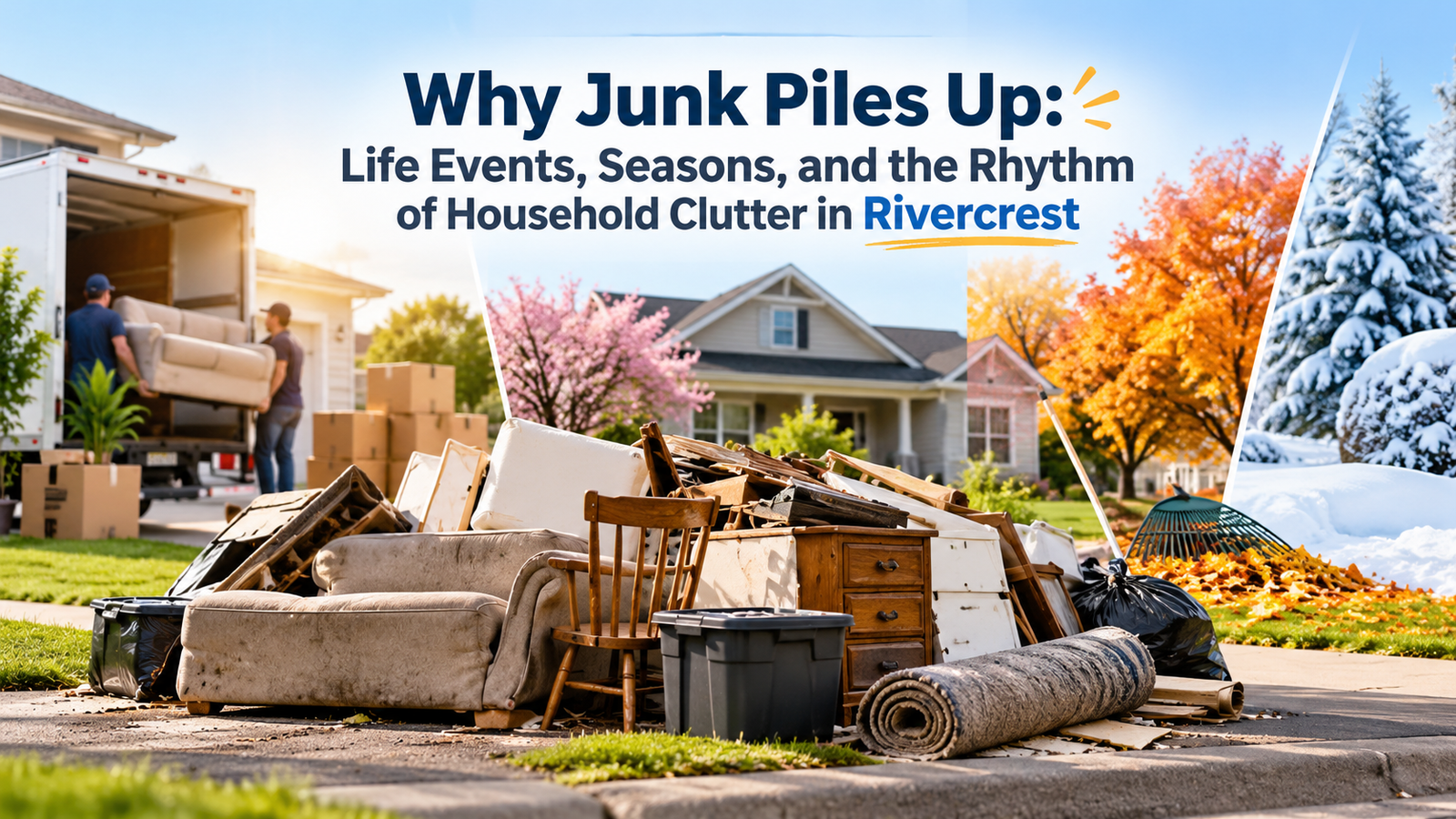
Nobody sets out to fill a garage with things they never use. Clutter arrives gradually, through ordinary life. A child grows and leaves behind a room full of belongings. A relative passes away and the family inherits a house. A renovation produces leftover materials. A season ends and its gear gets stuffed into a corner. Each of these moments adds to the pile, and each produces a recognizable kind of junk. Looking at clutter through the lens of life events explains a good deal about why it accumulates, what it is made of, and why clearing it out can feel so much heavier than the physical work alone.
This guide describes the common triggers behind household Junk removal service Rivercrest, the types of material each one tends to produce, and the general ways people and communities deal with them. It is set in Rivercrest, a neighborhood of Oregon City, Oregon, in the Willamette Valley, where a temperate, wet climate and a mix of established and newer homes shape how households live and store things. It is general information about the subject and not advice about a particular home.
The Psychology Under the Pile
Before looking at specific events, it helps to understand why people keep things at all. Researchers who study household clutter point to several overlapping reasons.
Possible future use. “I might need this” is probably the most common thought. A spare cable, an extra chair, or a half-used can of paint feels safer to keep than to discard.
Sentimental attachment. Objects carry memories. A crib, a school project, or a parent’s tool chest means more than its function.
Sunk effort or money. Something that was bought or built feels wasteful to throw out, even if it has not been touched in years.
Decision fatigue. Sorting is mentally tiring. It is easier to put a box in the garage than to open it.
Lack of an obvious next step. An item that is too good to trash but not valuable enough to sell often sits because no clear path exists.
Gradual change. Clutter grows so slowly that the household adapts without noticing.
These forces apply everywhere, but they intensify around life events, when large quantities of belongings change status all at once.
Moving: The Great Sorting
A move is the most common clutter trigger. Packing forces a household to confront everything it owns, and the decisions come under time pressure.
What a move produces.
- Furniture that does not fit the new space
- Duplicate kitchen items from merged households
- Packing materials, boxes, and bubble wrap after unpacking
- Old paint, cleaning supplies, and garden chemicals that cannot be transported safely
- Outgrown children’s items and sports gear
- Worn mattresses, rugs, and curtains
Common patterns. The most manageable moves involve sorting before packing, not after. Items that are moved and then discarded take effort twice. On the other side of the move, the empty cardboard produces its own volume, and it is generally recycled as long as it is clean and dry.
Many hazardous items cannot be moved by professional movers, so households are often left needing to dispose of them separately. Paint, propane, fuel, and aerosols are typical examples.
Downsizing: Smaller Space, Larger Decisions
Older adults moving from a family house into a smaller home, apartment, or assisted living community face one of the hardest kinds of sorting. Decades of belongings must be reduced to what fits in a fraction of the space.
Typical downsizing material.
- Dining sets, hutches, and china cabinets that no longer suit smaller rooms
- Large collections of books, records, or hobby supplies
- Tools and workshop equipment
- Seasonal decorations
- Duplicate kitchenware and linens
- Items kept for children who have since moved on
Why it is difficult. Each object has a history, and the process of letting go can be emotional. Practitioners who work in this area often suggest starting with less sentimental spaces, such as the garage or a guest room, and leaving photographs, letters, and heirlooms until later. Involving family members in choosing keepsakes can help reduce conflict and regret.
Estate Cleanouts
When someone dies, the home and its contents become the responsibility of family members or an executor. These situations combine emotion, logistics, and often legal requirements.
What makes estate cleanouts different.
- The volume can be large and the history unknown.
- Important documents may be mixed in with everyday papers.
- Valuables can be hidden in unexpected places.
- Legal and financial processes may influence timing.
- Family members may live far away and visit briefly.
- The house may need to be emptied before it can be sold or rented.
Typical steps. People often begin by locating important papers such as wills, deeds, insurance policies, and financial records. Next they identify items of value or sentimental significance, then agree on how to distribute them. Only after that does bulk clearing begin. Appraisers sometimes assess antiques, art, jewelry, and collectibles, and auction houses or estate sale organizers handle sales. What remains is donated, recycled, or disposed of.
Many families find that taking time, where possible, makes the process gentler.
Renovations and Repairs
Home improvements are a major source of construction-type junk.
Typical renovation material.
- Demolition debris such as drywall, lumber, and old flooring
- Fixtures including sinks, toilets, and cabinets
- Leftover tiles, paint, and lumber
- Packaging from new materials
- Old windows and doors
- Carpet and padding
Routing. Clean wood and metal are generally recyclable. Porcelain and concrete may be accepted at certain recycling facilities. Painted and treated wood has limited options. Older homes, built before the 1980s, may contain asbestos in flooring, siding, or insulation, and lead in paint. Disturbing those materials has regulatory implications, and testing before demolition is a widely recommended step.
Renovation waste tends to be heavy, so even small projects can generate more weight than expected.
Family Changes
Births, marriages, divorces, and children leaving home all reshape a household’s belongings.
- New babies bring equipment that is used briefly and then stored, such as cribs, strollers, and high chairs.
- Children leaving for college or independence leave behind bedrooms full of clothes, toys, and school materials.
- Combining households after marriage or partnership creates duplicates.
- Separation can divide possessions and leave one household with excess.
These moments often send items into garages and attics, where they stay for years.
Seasonal Rhythm
Even without a major life event, the calendar generates junk.
Spring. Winter damage, storm debris, and the urge to clean produce a wave of cleanouts. Garages are emptied, and yard work begins in earnest.
Summer. Outdoor projects, moves, and renovation season generate construction debris, old patio furniture, and pool supplies.
Fall. Leaf and branch debris peaks. Households prepare for winter by clearing storage.
Winter. Holiday packaging, replaced gifts, and decorations accumulate. Indoor projects like closet purges occur.
In the Willamette Valley, wet fall and winter weather also contributes. Damp storage causes mold, rot, and rust, converting stored goods into waste.
Rivercrest and the Local Picture
Rivercrest is part of Oregon City’s residential fabric, with homes ranging from established mid-century neighborhoods to more recent subdivisions. A few local features shape the pattern of household junk.
Mature trees and yards. Large Douglas firs, maples, and other trees drop branches, needles, and leaves. Yard debris is a frequent category.
Wet climate. Persistent rain and dampness degrade stored cardboard, fabric, and wood, so stored items may deteriorate before they are cleared.
Garages as storage. In many Pacific Northwest neighborhoods, garages double as storage rooms, workshops, and gear closets, and cars end up outside. That makes them frequent targets for cleanouts.
Outdoor lifestyle. Proximity to rivers, trails, and mountains encourages ownership of kayaks, bikes, camping gear, skis, and tools, much of which accumulates.
Growing households. Families in the area range from long-time residents to newer arrivals who bring and shed belongings.
Local waste systems. Garbage and recycling collection in Oregon City operates through franchised service, and the Portland region has established facilities for hazardous waste, electronics, and mattress recycling. Residents typically check service provider guidelines to see what is accepted at the curb.
What Happens to Things When They Leave
Whatever the trigger, the material tends to follow similar paths.
Reuse. Furniture, housewares, clothing, tools, and toys in good condition move through donation centers and secondhand shops.
Recycling. Metal, electronics, cardboard, and certain plastics go to specialized processors.
Composting. Yard debris is processed into compost.
Specialized collection. Hazardous materials, mattresses, and certain appliances follow separate programs.
Disposal. Worn out, contaminated, or mixed material goes to transfer stations and landfills.
Households who sort ahead make it easier for each of those paths to work.
Gentle Strategies for Tackling a Pile
Because clutter has emotional dimensions, practical approaches that respect them tend to be more sustainable.
- Start small. One shelf, one closet, or one corner builds confidence.
- Set time limits. Short sessions reduce fatigue.
- Use a clear category system. Keep, donate, recycle, hazardous, trash.
- Handle each item once. Make a decision rather than moving it around.
- Take photographs of sentimental items. A picture can preserve the memory when the object cannot be kept.
- Choose a destination for donations right away. Items that stay in the car trunk for months defeat the purpose.
- Ask for help. A friend or family member can provide perspective and physical help.
- Pause for safety. Heavy items, ladders, and attic access deserve caution.
Common Misunderstandings
“Clutter is a sign of laziness.” It is more often a natural result of life changes and time pressure.
“Everything must be decided at once.” Staged decisions work better, especially after a loss.
“Old items always have value.” Some do, but many have little resale value, and appraisal is the way to tell.
“Donating clears the problem.” Charities cannot accept everything, and unusable donations create work for them.
“Moving is the best time to sort.” Sorting before packing is usually less stressful than sorting during or after.
Frequently Asked Questions
Why does clutter build up in garages?
Garages combine empty space with a lack of daily scrutiny, so items are placed there temporarily and stay.
What is the hardest part of clearing a loved one’s home?
The emotional weight. Each item can carry memories, so many families spread the process over time and separate valuables from bulk items.
How do I decide what to keep?
Common questions include whether the item is used, whether it has a place, whether it has sentimental meaning, and whether it is replaceable.
What happens to items I donate?
Usable goods are sold or distributed. Items that cannot be used are sorted and disposed of or recycled by the charity.
Can leftover paint be thrown away?
Liquid paint is usually treated as household hazardous waste in the Portland area and is accepted at designated facilities. Dried paint is handled differently, according to local guidelines.
Is it normal to feel overwhelmed by a cleanout?
Yes. The combination of volume, decisions, and emotion is a common reason people postpone the work.
What items typically require special disposal?
Batteries, chemicals, fluorescent bulbs, certain electronics, refrigerant appliances, and mattresses.
How can I reduce junk in the future?
Regular small purges, a one-in-one-out habit, and avoiding impulse purchases help limit accumulation.
Final Thoughts
Junk is rarely random. It follows life, arriving with moves, losses, renovations, new babies, and changing seasons. Understanding the pattern turns an overwhelming heap into a set of smaller, nameable problems, each with a known path for reuse, recycling, or disposal.
For readers interested in how a junk removal service in Rivercrest fits into the life of an Oregon City neighborhood, the key idea is that the work reflects ordinary transitions. A wet climate, active households, and a well-developed regional recycling system shape what leaves a property and where it ends up, and seeing the human story behind the pile makes the practical story easier to understand.